

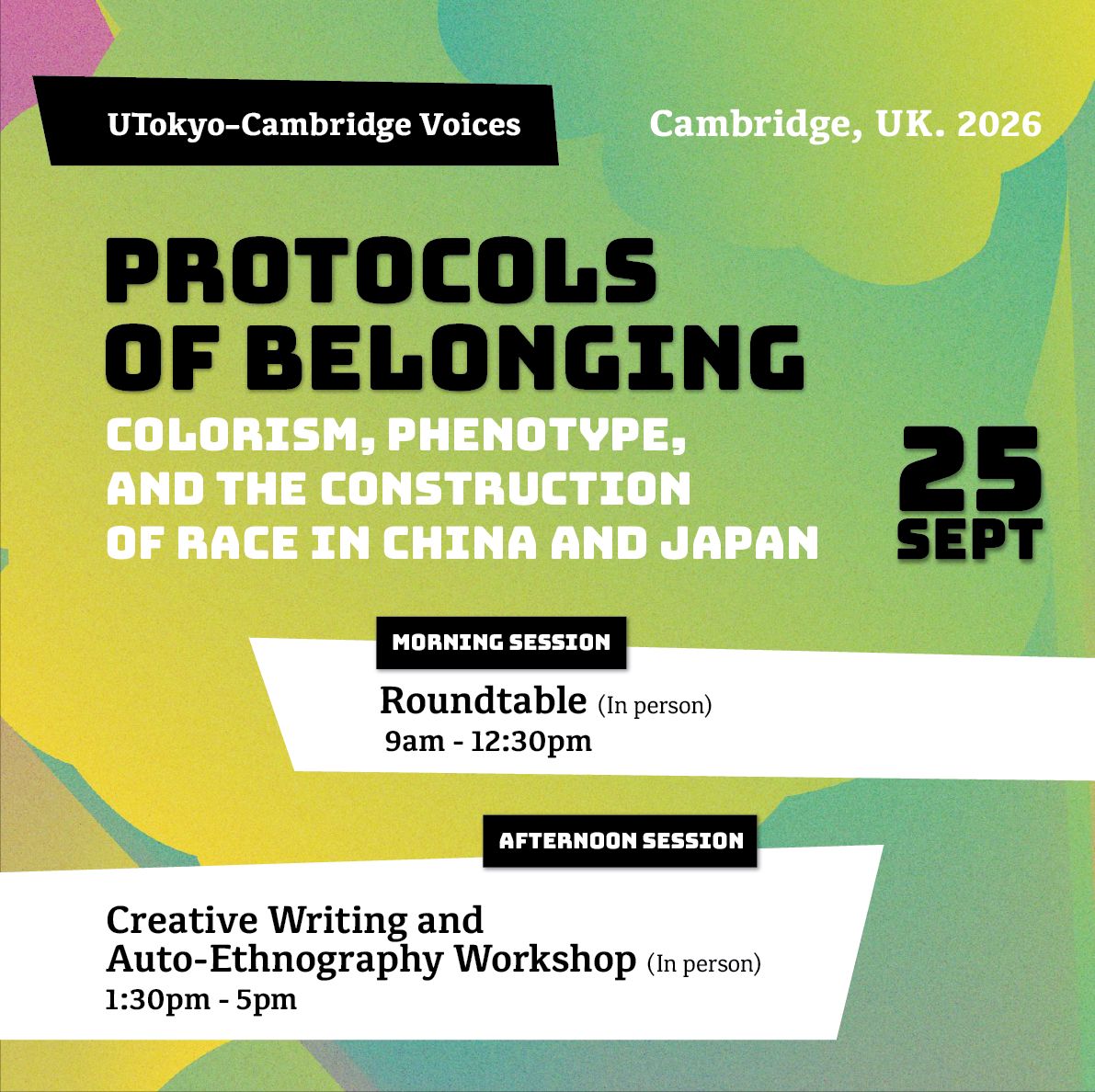
Part of UTokyo–Cambridge Voices 2026, this symposium brings together researchers working across critical race studies, East Asian studies and postcolonial theory to examine how race is constructed, translated and embodied in China and Japan.
When: 25 September 2026, 9:00–17:00
Where: Sociology Seminar Room, Department of Sociology, University of Cambridge, Free School Lane, Cambridge CB2 3RQ
What does it mean to be seen and to be read within the imagined communities of China and Japan?
This symposium invites participants into a collaborative conversation about how race is constructed, translated, and embodied in two national contexts that have often been positioned as outside of Western racial frameworks. We begin from the conviction that understanding race in Asia requires both a relational perspective on global histories of racial thought and careful attentiveness to the distinct cultural and linguistic grammars through which racism operates locally.
We take colorism as a generative analytical starting point rather than a straightforwardly applicable framework. In Japan, the Meiji government’s project of erasing race in favour of ethnicity functioned as a technology of domestication and containment, drawing people into a unified national body while simultaneously obscuring the racialisation it produced. This move bears a striking parallel to China’s official discourse of the multiethnic nation, in which the recognition of fifty-six ethnic groups coexists with a Han-centric normativity that shapes who is seen as fully belonging. Rather than assuming colorism translates directly into these contexts, this symposium takes it as a starting point for asking how race has been formed, contested, and lived in China and Japan. Among the threads we follow is the ideal of whiteness, which surfaces in registers as different as skin-whitening practices in China and the historical positioning of Japanese migrants as “honorary whites” in Brazil, and which travels across national frameworks in ways that reward careful scrutiny.
Drawing on Takezawa’s theorisation of the visibility and invisibility of racism, we also attend to how racial difference is rendered illegible or denied within these two specific national contexts. In Japan, surnames, accents, and mixed-race status mark the boundaries of a national identity premised on ethnic homogeneity, while indigenous and ethnic minority communities continue to experience racialisation that official narratives routinely obscure. In China, the official recognition of fifty-six ethnic groups coexists with a Han-centric normativity that shapes who is seen as fully belonging to the national community.
Programme
This symposium is organised across two sessions. The morning session convenes as a roundtable discussion, and the afternoon session takes the form of a creative writing and auto-ethnography workshop.
Morning session: Roundtable
9:00–12:30
In person
The morning session is convened as a roundtable. This session welcomes scholars across critical race studies, East Asian studies, and postcolonial theory to think collectively about how race is made, unmade, and contested in Asia.
Lunch will be provided between the morning and afternoon sessions.
Afternoon session: Creative Writing and Auto-ethnography Workshop
13:30–17:00
In person
The afternoon session extends the morning’s conversations into the register of creative practice. Participants are invited to engage with questions of race, belonging, and embodied experience through creative writing and auto-ethnographic reflection, exploring how personal narrative and situated knowledge can illuminate what more conventional academic forms sometimes leave unsaid. This session is designed as a collaborative and generative space, warmly welcoming all participants from the morning roundtable to continue the conversation through the register of creative practice.
Organisers
Professor Mónica Moreno Figueroa
Department of Sociology
University of Cambridge
Mónica Moreno Figueroa is a Professor of Sociology at the University of Cambridge and a Fellow in Social Sciences at Downing College, Cambridge. Her research has primarily developed around three areas: the lived experience of ‘race’ and racism; feminist theory and the interconnections between beauty, emotions and racism; visual methodologies and applied research collaborations. She completed an undergraduate degree in Media and Communication at the Universidad Iberoamericana, León, Mexico in 1996, before moving to the Universidad Iberoamericana, Mexico City, to study an MA in Sociology. In 1999, she travelled to the UK to do an MA in Gender, Culture and Modernity at Goldsmiths College, London, where she stayed to take a PhD in Sociology. She has lectured at Goldsmiths and Birkbeck College, London, the University of Nottingham, Newcastle University, Princeton University and El Colegio de México.
An integral part of her academic work has been her commitment to exploring different forms of engaged and engaging sociology with a deep concern for social justice. This has taken her to develop collaborations and projects that aim to make racism public. In the summer of 2011, Mónica co-founded the Collective COPERA (Colectivo para Eliminar el Racismo en México) with the leadership of Dr Emiko Saldivar (University of California-SB) and Dr Alicia Castellanos (UAM-Iztapalapa), which has now grown to include a wider group of academics and activists. The collective has been developing a series of initiatives to make racism public in Mexico, visibilise racism in its multiple forms of expression in the country and incorporate a ‘race’ and racism perspective in public policy and social activism. COPERA is part of the Network of Antiracist Action and Research, RAIAR.
She is currently leading the development of the Global Racisms Institute for Social Transformation (GRIST) in the Department of Sociology, established with seed funding from the W.K. Kellogg Foundation. GRIST is an interdisciplinary hub designed to foster curiosity, collaboration and transformation in the study of global racisms and intersectional inequalities. She recently completed a British Academy Mid-Career Fellowship (2022–23) for the project The Structure Within: Internalised Oppression, Defensiveness and Resentment, which has produced a forthcoming book, a podcast, an animation film and a social media campaign to position the topic of internalised oppression in discussions of activism and social transformation.
Ms Jing Jyng Chang
Department of Sociology
University of Cambridge
Jing Jyng Chang is a PhD candidate in the Department of Sociology at the University of Cambridge, supervised by Professor Mónica Moreno Figueroa. She holds an MSc in African Studies and International Development and an MA in International Relations, both from the University of Edinburgh.
Her doctoral research examines suzhi (素质) discourse as a racial grammar in contemporary China, focusing on highly educated, unmarried urban women, known as “sheng nü” (剩女, “leftover women”), as her primary research population, and explores how race and gender are mutually constituted within this discourse rather than simply layered upon one another. Methodologically, she works as a qualitative researcher employing Photovoice, a participatory, image-based method.
Her work draws on critical race theory, Black feminist thought, and postcolonial perspectives on knowledge production. Alongside her research, she is actively involved in NGO work, currently serving as Representative of the Research and Policy Department at the UK branch of AWDPI (Asian Women Development Plan International).
Ms Yiyun Bai
Department of Sociology
University of Cambridge
Yiyun Bai is a PhD student in the Department of Sociology at the University of Cambridge, where she previously completed her MPhil in Sociology of Media and Culture. She also holds an MSc in Media and Communications from the London School of Economics and Political Science (LSE).
Her doctoral research takes an intersectional approach to examining transnational assisted reproduction among Chinese single women and lesbian couples, with particular attention to the racialised dynamics shaping gamete donor selection. Methodologically, she works as a qualitative researcher employing multi-sited ethnography, with an interest in art-based and creative methods.
Alongside her research, Yiyun served as PhD Student Representative for the 2024/25 academic year in the Department of Sociology and currently sits on the Early Career Researchers (ECR) Committee at Cambridge Reproduction. Before joining Cambridge, she worked as International Affairs Officer at Peking University and has been actively involved in anti-racism and public engagement initiatives.
Ms Yue Zhong
Department of Sociology
University of Cambridge
Yue Zhong is a PhD researcher in Sociology at the University of Cambridge. Her research examines the lived experiences of Chinese women in intimate relationships with Black African men in China. It explores how race, gender, nationality and intimacy intersect in these women’s relationships, family lives and everyday social encounters. Her qualitative research combines ethnographic fieldwork in Guangzhou with in-depth interviews with Chinese women living in different cities across China and the analysis of relevant online discussions.
Before beginning her PhD, Yue earned an MA in Intercultural Communication and Education from Durham University and a BA in English and Arabic from Sun Yat-sen University. She was also an exchange student at the Hebrew University of Jerusalem from 2018 to 2019, where she studied International Relations.
Beyond her academic work, Yue is committed to advancing gender equality in academia and the workplace. She co-founded a community that provides free academic consultation and networking opportunities for early-career women researchers. She has also volunteered with NGOs and community initiatives that support women’s professional and academic development.
Mateus R. Oliveira
Graduate School of Interdisciplinary Information Studies
The University of Tokyo
PhD Candidate at the University of Tokyo’s Graduate School of Interdisciplinary Information Studies, researching how international legal frameworks such as the United Nations Declaration on the Rights of Indigenous Peoples shape debates and discourse on ethnicity and indigeneity in Japan, with a focus on the Ryukyuan community. Also serves as Senior Design Lead at Moon Creative Lab, Mitsui & Co. enterprise accelerator.
This event is organised in collaboration between GRIST and the UTokyo–Cambridge Strategic Partnership, as part of the Cambridge–UTokyo Joint Symposium.